

Sundar Ranganathan, Senior Product Manager for NetApp ONTAP.
Machine Learning (ML) algorithms and deep learning (DL) techniques are driving efficiencies across use cases solving problems around image classification, object detection, regression, natural language processing, ensemble learning and others. These techniques work with a multitude of data sets like text, log, time series, images, audio etc.
In this blog, we will examine the top AI use cases in the financial sector, retail, and government verticals. We will also present a fraud detection case study applicable in the financial vertical. In part-1 of this series, we discussed the top AI use cases in the manufacturing, telecom, and healthcare verticals.
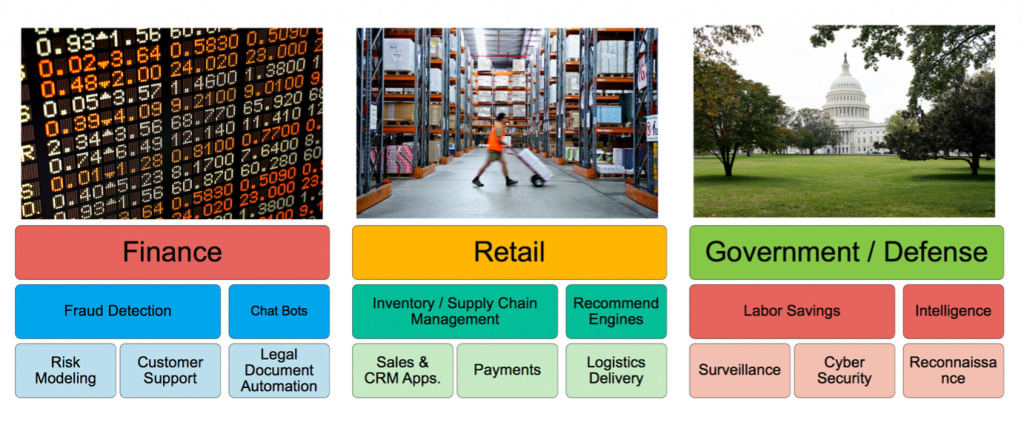
AI Use Cases in Retail
Use of AI in the retail segment centers around solving optimization problems in supply chain, inventor levels, pricing and focusing on improving customer experience.
The top AI use cases in retail revolve around –
- Supply chain and Inventory
management: Losses from overstocks amount to around $123.4B/yr and losses from out-of-stock items reach $129.5B/yr in North America alone. This is a top area of focus in companies especially
with a large footprint of stores and fulfilment centers spread across
geographic locations. Retail stores are now using AI to forecast demands,
understand buying patterns, manage inventory levels, and reduce the losses
resulting from out-of-stock and over-stock SKUs. This involves performing gap
analysis to forecast and replenish items to the right levels suited to each
store, optimally display, and group cross-promotional items.
- Example: Blue Yonder, a leading provider of AI solutions for Retail uses AI to reduce losses from out-of-stock and overstocks.
- Pricing Optimization: This is a
segment with razor thin margins so optimizing on pricing directly improves the
organization’s bottom line and top line revenue. This includes but not limited
to (1) identifying multiple factors that affect pricing like weather, market
conditions, and in-store metrics, (2) determining optimal price points for new
products and automatically reacting to competitors’ pricing.
- Example: Salesforce’s Einstein Discovery is an AI powered tool for price optimization and Wise Athena uses ML to predict SKU pricing/demand and analyze how pricing may affect product cannibalization.
- Experiential retail and communication: Use of AI to offer a better shopping experience finding new ways to engage with customers, and auto suggestions with personalized recommendation engines. Check-out free stores are powered by a fusion of computer vision/facial recognition and AI techniques. Conversational robots provide digital mapping and indoor location-based services, chat bots enhance customer care, and voice enabled shopping takes shopping convenience to the next level.
AI Use Cases in Finance
AI adopters in the finance sector with a proactive strategy have significantly higher profit margins. AI is leveraged in use cases spanning banking, insurance, securities, and investment services. The systems apply AI techniques to unstructured data sources to derive critical investment and risk indicators in shorter times than traditional methods.
The top AI use cases in finance revolve around –
- Fraud detection: AI systems use
rule-based learning and techniques to extract, interpret, discover, and
associate relevant insights enabling identification of transactions that
indicate patterns of fraudulent activity. Few companies are using AI to help
banks around the world verify the information stored in customer records as
part of the know-your-customer (KYC) efforts.
- Examples: Trifacta and NiceActimize are two companies using AI to detect fraud. Onfido provides identity validation solutions by authenticating a person’s identity documents and comparing them with facial biometrics and cross-referencing them against international credit and watch list databases. ZAML is a ML platform developed by ZestFinance used to score customers with a limited credit history.
- Recommendation systems: A
common use case that applies in finance, insurance, and investment services.
The systems utilize AI capabilities to learn and offers personalized investment
recommendations based on individual investment goals, risk tolerance, and the
market climate. AI models are trained to assist applicants with the correct
level of insurance product. Similarly, such techniques are used to process and
extract insights from loan/mortgage data and applications.
- Examples: Next Best Action from Morgan Stanley is an ML platform for advisors to suggest trades and automate routine tasks. COIN (Contract Intelligence) used by JPMC analyzes legal documents and extracts important data points and clauses. AIERA (Artificial Intelligence Equity Research Analyst) from Wells Fargo tracks stocks and formulates a view if it will go up or down.
- Customer care bots: Learning
methods put to use to interpret and automate customer needs and problems, this
results in driving up efficiencies and savings across the banking, insurance,
and securities industries. Models are trained with text data sets using NLP
methods and most commonly pushed to smartphones for inferencing.
- Examples: Erica from Bank of America is an AI driven chatbot. Wells Fargo uses a similar approach.
AI Use Cases in Defense/Government
Broadly speaking, there are two areas were
AI is being leveraged – driving cost efficiencies through automation in
government offices and in military use cases.
The top AI use cases in government revolve around –
- Optimization and Savings: Cognitive technologies will change the nature of many government jobs where common problems encountered are resource constraints, the need to parse through lots of info. to reach a decision, and paperwork killing productivity. The AI based applications help reduce backlog, cut costs, overcomes resource constraints through automation and in turn improves accuracy. Per Deloitte’s research AI in government can drive massive labor cost savings with projections of $41.1B in 5-7 years with high levels of investments in AI.
- Defense: Global AI & robotics in the defense market is valued at $39.22B in 2018 and Is projected to grow to $61B by 2027. Robotics, NLP, computer vision, speech recognition are the top techniques to be leveraged. AI powered drones are used for intelligence, ML powered robots for search and rescue, use of DL to create situational awareness for robots and drones. As military sites are digitized, they need to be secured and need to respond to malware, and phishing attacks on data centers. AI is increasingly being leveraged for these critical tasks.
Fraud Detection Case Study with ONTAP AI
As part of our research into the AI use cases across verticals, we ran a few use cases in each vertical on our ONTAP AI platform.
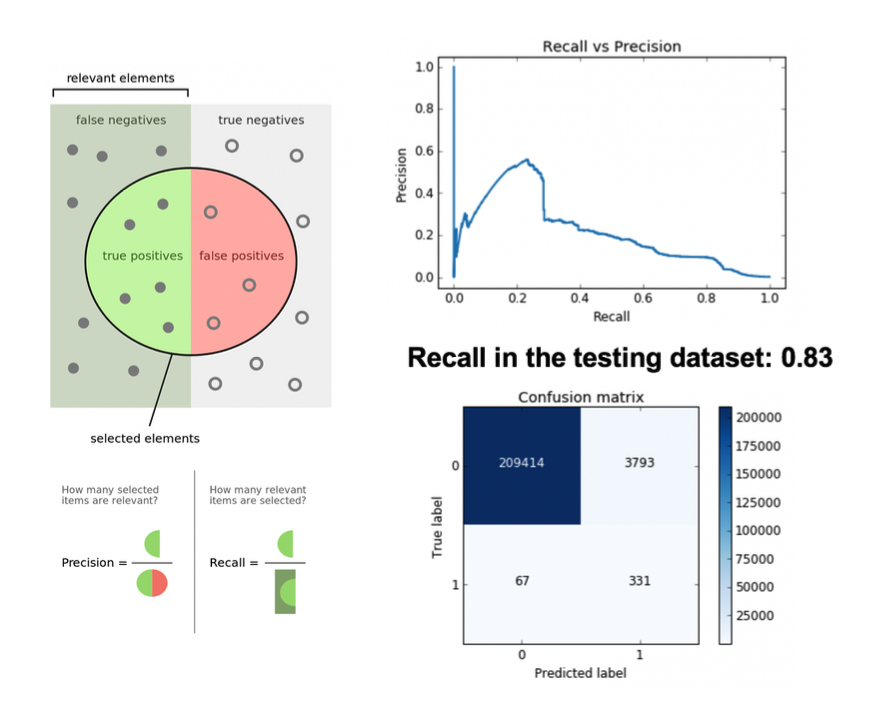
This is a financial related use case to recognize fraudulent credit card transactions, so customers are not charged for items they did not purchase. We used a data set from Kaggle with credit card transactions made by European card holders in Sept 2013 and Autoencoders which is a type of neural network used to learn efficient data coding in an unsupervised manner.
With this mechanism, we need to define the line to classify whether a transaction is fraudulent or not. This is a business decision with tradeoff precision (ratio of relevant instances among the retrieved instances) and recall (ratio of relevant instances retrieved over the total number of relevant instances). In our example, we focused on a higher recall value and picked a threshold for achieving a 0.83 recall. These values are of course limited due to the small data set used but it showcases the art of the possible with ONTAP AI.
AI applications across most verticals require some level of data orchestration between edge, core, and cloud, as a result seamless data management becomes important. Depending on the data source, size of data set, and cost points, organizations can choose to develop AI apps on public clouds or on-premises. For more information, please visit https://www.netapp.com/us/solutions/applications/ai-deep-learning.aspx?ref_source=redir-ai.